.jpg "Savills")
Letting activity at one of the highest levels ever recorded
Warsaw ranked the second in fDI Intelligence - European Cities & Regions of the Future 2022 / 2023 in the business friendliness category.
The low developer activity we have seen in the city for some time translates into a low share of pre-leases, which in 2022 amounted to only 10% of the lease volume. Renegotiations and contract extensions accounted for arelatively high share of gross demand. In the coming months, tenants will face significant rent indexations and further increases in service charges due to high inflation.
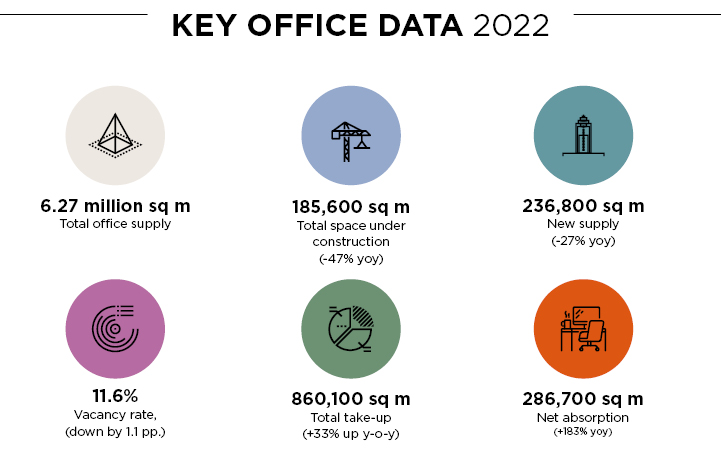
An important group of office tenants is made up of companies from the IT sector, who in recent years have taken a particular liking to the central hubs, mainly the City Centre West office subzone. Over the next few years, we will see historically low values for new office supply, which will translate into declining availability of office space in the city (which at the end of December 2022 stood at 11.6%) especially in the most popular locations. In 2022, we recorded the second highest volume of demand for office space (over 860,000 sq m), with net absorption reaching just under 287,000 sq m.
Why Warsaw
The Polish economy, according to the latest preliminary data byStatistics Poland, recorded a growth of 4.9% in 2022. Recent years for the global economy have not been very favourable. First a pandemic that resulted in a 3.5% drop in global GDP in 2020, followed by a temporary rebound in 2021. A solid growth in 2021 was followed by further economic headwinds and obstacles in 2022. The geopolitical and economic situation last year was tense. The last year was dominated by the war in Ukraine, which resulted in significant increases in consumer price index, especially in Europe. While the Polish economy, according to the latest forecasts by economists from Oxford Economics, should record a growth of 5.8% in 2022, mainly due to a good first half of the year, economic stagnation and a decrease in investments are expected in 2023. The biggest challenge for the Polish economy in the coming quarters will be to beat the high inflation, which stood at 13.2% in 2022 and in 2023 should reach approximately 15% with a gradual decline in 2024, approaching the inflation goal after 2025.
Analysing the economic situation of the CEE capital cities, it appears that Warsaw has done very well in the the Covid-19 pandemic in 2020, recording one of the lowest GDP declines. In 2021-2022, Warsaw recorded some of the highest economic growths in the region. These solid fundamentals lead to forecasts for the coming years, in which the stagnation of 2023 should turn back into some of the highest economic growth in the region.
With office based employment exceeding 542,000 people Warsaw is second largest service centre in CEE region, just after Budapest.
Wioleta Wojtczak, Head of Research
Office Market
Supply
At the end of December 2022, the total stock of modern office space in Warsaw was 6.27 milion sq m, of which 2.78 milion sq m was in the central zones and 3.48 milion sq m in non-central zones. The largest office zones include the City Centre (1.79 million sq m), Mokotów (1.48 million sq m) and CBD (991,800 sq m).
In 2022, a total of 236,800 sq m of office space was delivered in 12 projects. New supply was dominated by the central zones (a total of 79% space in 8 projects). The largest projects delivered include Varso Tower (63,800 sq m) in the CBD zone and Forest Tower (51,500 sq m) in the City Centre zone. Both projects were built by HB Reavis. Another significant project completed last year was the SKYSAWA complex with a total area of 31,300 sq m in the CBD zone constructed by PHN. The largest non-central development was P180 (32,000 sq m) completed by Skanska Property Poland in the Mokotów zone.
.jpg "Image treatment")
Office Market
Demand
The developed office real estate market in Warsaw, combined with a large pool of skilled labour, has resulted in the city's position as a destination for the location of shared service centres. Based on the ABSL 2022 report on the modern business services sector in Poland, Warsaw is the largest BPO/SSC centre in terms of the number of operating business service centres. There are currently 330 centres operating in the city, where 82 600 people are employed (the second result in the country after Kraków). Employment in 51 centres exceeds 500 people. The cumulative increase in employment in the analysed sector between 2017 and 2022 was 13.7%, which is the highest result in the country.
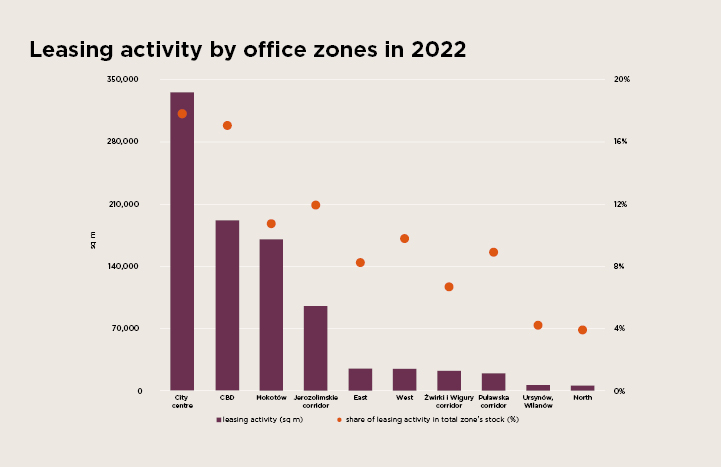
Demand in 2022 reached some of the highest levels ever and was at the level of recent record years before the pandemic (850,000 - 870,000 sq m). Tenants generated demand of 860,100 sq m last year, 33% higher than in 2021.
Office market
Rents
Headline rents in central zones remain stable and range between EUR 21.00 - 25.50/sq m/month. Tenants interested in the top floors in centrally located high-rise buildings must be prepared to pay higher rates for vacant modules, deviating from the average rates on the market. In Służewiec, which is the largest office zone outside the city centre, rents for the most attractive modules oscillate around EUR 13.00 - 15.00 sq m/month.
One of the elements that have held back rent growth in recent months has undoubtedly been the increases in maintenance fees that tenants have had to face. The long-lasting high inflation in Poland and the Eurozone, combined with increases in the minimum wage and other charges, will negatively affect office rental rates in the near future. In the coming months, tenants will face significant rent indexations and further increases in service charges, the first changes of which we observed last year. A trend that has intensified recently is the extension of leases, which can provide a reliable solution to the rising costs of maintenance and fitout of space by landlords.
Office market
Vacancy
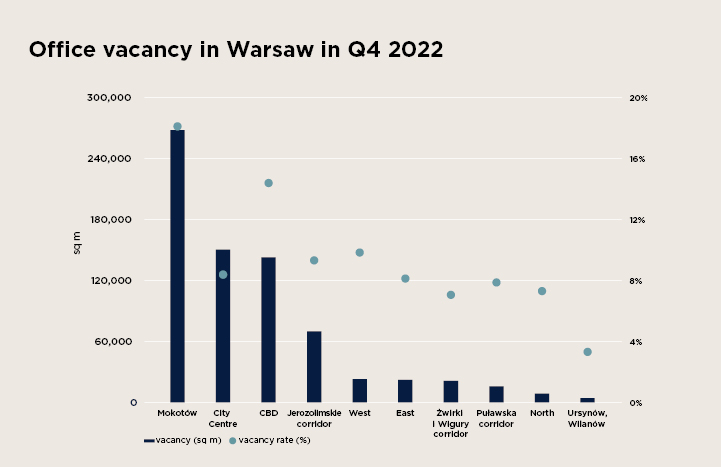
At the end of December 2022, the amount of vacant space offered for lease in Warsaw was approximately 726,400 sq m, which translates into a vacancy rate of 11.59%. Compared to the end of 2021, a decrease of more than 52,000 sq m, or 107 bps, was recorded. Over the last year, the decrease in space was recorded in the central zones (54,000 sq m), while there was a minimal increase of 2,000 sq m of available space in non-central zones.
There is currently around 293,200 sq m available for occupiers in the central zones. (10.53%) and 433,200 sq m (12.43%), outside the centre. Of all the office zones, the most vacant space is located within the CBD (142,900 sq m), in the City Centre - more than 150,400 sq m, where the vast majority, i.e. 92,300 sq m, is located in the vicinity of Rondo Daszyńskiego (sub-zone City Centre West) and in Mokotów (268,000 sq m, of which 212,500 sq m in Służewiec subzne). On the other hand, the zones with the least vacant space are: Ursynów and Wilanów - 4,200 sq m and North, where 8,800 sq m of vacant office space awaits tenants.